
From the Molecular Level Upward: A Conversation with Forrest Gander
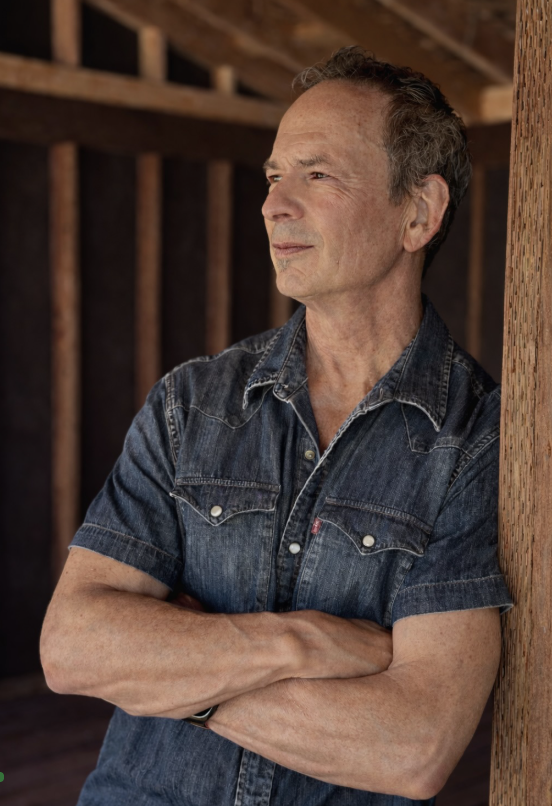
Forrest Gander 2026, by Ashwini Bhat
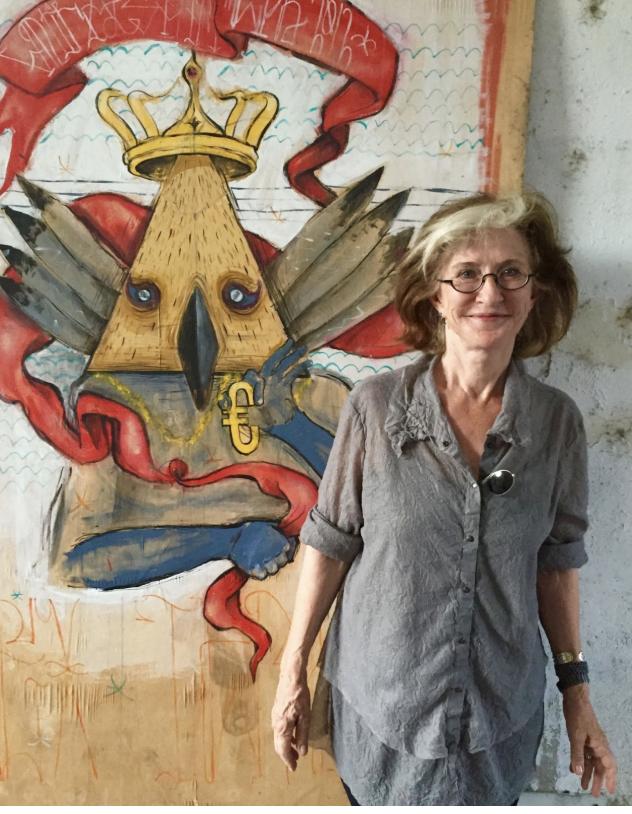
C.D. Wright 2015, by Forrest Gander
This interview centers on two texts: Pulitzer Prize winner Forrest Gander’s novel poem called Mojave Ghost (New Directions, 2024), and The Essential C.D. Wright (Copper Canyon Press, 2025), a selection of C.D. Wright’s oeuvre of poetry which Gander edited with Michael Wiegers, C.D. Wright’s editor at Copper Canyon Press.
C.D. Wright and Forrest Gander were married from 1983 until Wright’s death in 2016. Her death has deeply informed Gander’s already-held beliefs about nature, connection, and the ways in which we constantly return to one another in new forms. These ideas are at the crux of Mojave Ghost, in which Gander roams the Mojave Desert and explores the shared territory of memory and the present moment in “the fractures and folds that underlie not only my country, but any self in its relationship with others.”
Born in the Mojave Desert, Pulitzer Prize-winning writer/translator Forrest Gander has degrees in geology and literature. A signal voice for environmental poetics, his work often focuses on human and ecological intimacies. His latest books are Mojave Ghost: a Novel Poem and his translation, Even Time Bleeds: Selected Poems of Jeannette L. Clariond.
C. D. Wright was one of the most influential and vital North American poets of her generation. After her sudden, unexpected death in 2016, the New York Times obituary noted that she was so uniquely original that she “constituted a school of exactly one.” Although she was known as a lyric and elliptical poet, she drew from narrative and documentary poetics to write books defined by their wry humor, their ethical orientation, and their inventive formal strategies. She grew up in the Ozarks of Arkansas as the daughter of a country judge and a court reporter. There she picked up a keen vernacular voice that came to characterize much of her writing. Wright was married to the poet Forrest Gander from 1983 until her death; they had one child, the artist Brecht Wright Gander. Among many prestigious honors, Wright received a MacArthur “Genius” Fellowship, a Guggenheim Fellowship, the National Book Critics Circle Award, the Lenore Marshall Prize, and the Griffin Poetry Prize. Since her death, the Foundation of Contemporary Arts has funded an annual C. D. Wright Prize; an annual C. D. Wright Women’s Writers’ Conference was launched; Brown University established into perpetuity a C. D. Wright Memorial Lecture/Performance, and books of critical essays on her work are forthcoming. The Essential CD Wright was published in 2025 by Copper Canyon Press.
Indovina: At the beginning of Mojave Ghost, you included a quote from the introduction to your previous collection Twice Alive: “Isn’t it often in our most intimate relations that we come to realize that our identity, all identity, is combinatory?” Since I had read Twice Alive prior to reading Mojave Ghost, I thought about the differences in form between the collections, the former being mostly composed of shorter poems, and the latter being a novel poem. What prompted this shift in form for you? And how do you find that Twice Alive and Mojave Ghost are related?
Forrest Gander: Well, how do you think of form when you write? It’s probably the same way.
I: At least when I think about it, shorter works are focused on a moment in time, whereas I feel like book-length works are more of a larger survey of a concept or a theme.
FG: There’s a writer who was very important to me both personally and literarily: Robert Creeley, who became famous for the poems in his book For Love, little jewels that he found he could write fairly easily. He supposedly would write a poem, rip it out of the typewriter, and write another one, and was good to go. But he became dissatisfied with the notion of the poem as a finished object. And he went on to write a strange book called Pieces, which in fact is a long poem of connected and disconnected pieces that represented more of what his life felt like, his sense of reality, as opposed to the closed, kind of “perfect ending” poem. I like both. I love those early poems of his, but I’ve become interested in how, after you finish looking at something for the first time, if you come at it again the next day, you might find a different trajectory into what you said: the conceptual material. So I’ve come to write longer poems in that way, often sequences, as a means of maintaining interest in what might open up, what might surprise me, what the poem draws out of me from the banks of the unknown after I’ve written down what I’ve known. There are long poems in both Twice Alive and Mojave Ghost, but Mojave Ghost walks the form out across a geography also, starting in the Arkansas Ozarks and then moving north to south along the San Andreas Fault, and without any titles. So it’s even more extended.
I: We met in-person at the Max Ritvo Poetry Series reading last month [February 2026], which was beautiful, by the way. And you read from Mojave Ghost. Whenever I read a poetry collection, I love to read it out loud.
FG: I love to hear that! Me too.
I: I have a theater background, so I loved that you read the asterisk at the beginning of each of those sections as this exhale, which felt to me like a stilling of the self while reading. But it was also like that desert wind in the Mojave Desert. How did you arrive at that choice?
FG: Since there weren’t titles to separate the poems in the sequence, and since I didn’t want a full stop that would interrupt the ongoingness, I tried to figure out an appropriate transition. I came up with that little asterisk, which I think of as the first star of evening floating above each poem.
I: Because it’s centered above each poem. I totally see that now.
FG: But how do you represent something visual that way at a public reading? I didn’t want to make it overly dramatic, but I also think that, like you coming out of theater, poetry is essentially an embodied art. And this long poem is about a physical journey, walking in the desert, where you hear your own breath as well as the wind. The first time I read it to an audience, I was dissatisfied with just the pause. And it occurred to me to try an audible exhale of breath as a representation of the asterisk.
I: It feels like you’re dropping into each individual scene. And I also noticed that throughout Mojave Ghost, the speaker is reckoning with the relationship between the self and the collective. I couldn’t help but think of Walt Whitman, especially “Song of Myself.” Walt Whitman was my introduction to poetry,so naturally, I love his quote you’ve used at the beginning of Twice Alive: “Who need be afraid of the merge?” I’ve been thinking about Mojave Ghost and “Song of Myself” in communication, and I wanted to ask: when did you realize the relationship between poetry and the earth, and the self and the collective? And when did the epiphany of there being, as you state in Mojave Ghost, “no gap between the first- and third- / person perspectives,” land for you?
FG: Like you, Whitman is centrally important to me. And his sense of our being a part of a world of others, and otherness. The way he understood imagination allowing us to make contact with that otherness. I majored in Geology, so I’ve been looking at rocks and the earth for a long time, and the more deeply I became involved, the more I realize that the earth is constantly speaking to us, that the rocks are vibrating, that the sun is reflecting off of them and soliciting our gaze, that earth’s gravity affects our body in every way. And that different landscapes alter the rhythm of our walking and maybe the rhythm of our perceptions. So, that sense of being a part of the Earth comes out of my experience studying Geology.
That other sense you bring up, the awareness that there’s someone in me who’s watching me all of the time and commenting, a companion voice to “my” voice, and that there’s a sort of code-switching between the two–well, I think that may not be so uncommon. I wanted to represent that, because the lyric “I” is so often represented as a singular voice. Tamura Ryuichi, a World-War-II era Japanese poet, noted that the ultimate achievement of the singular voice, of the unitary speaking voice, is the atomic bomb. It’s something that blasts everything else away. That’s not the voice that I want to enact. I realize there are others speaking through me constantly. And of course, all of my words come from others. I’m using a language that’s been handed down to me and others over and over. So, it seems important to be cognizant of that as a writer, and one way of engaging that complexity is through this shifting of perspectives and pronouns.
I: I really appreciate what you said about the “I,” and how, in the separation of the “I,” there’s this against-ness to the collective in a way. Like when “I” is looking out onto the rest. Whereas with “we,” or even third-person pronouns, there’s no boundary between the self and the environment, as it is depicted in Mojave Ghost.
FG: And that seems relevant to ecological consciousness also. Because if we see a world of inanimate objects, then it becomes a world we can exploit. But an object, as Robert Hass notes, is just something from which we’ve removed ourselves. In truth, we’re connected to everything, from the molecular level upward. And if we became more conscious of that mutuality, we might live in this world of others and otherness more ethically and less transactionally.
I: Regarding The Essential C.D. Wright, I see that in C.D. Wright’s work too, especially with her more docupoetic works like One Big Self and One With Others [a little book of her days], as you’ve exhibited them in The Essential C.D. Wright with Michael Wiegers. I love that she’s also writing like an educator. After all, you both are teachers and educators,talking about the relationship between the self and others. What has returning to C.D.’s body of work taught you about poetry? And what did you teach each other throughout your lives as poets?
FG: She taught me everything about poetry. I wouldn’t be the poet or person I am now but for her. She was bitten to the core by poetry. It amazed me. And to be around her was to catch that fire. So, her importance to me and to others—and now, wherever I travel, people come up to me to tell me how important C.D.'s work is to them– is beyond measure. Because she’s such a singular writer. Her obituary in the New York Times quotes someone who wrote that, as a writer, she constituted “a school of exactly one.” That’s true, and it makes her work very hard to translate, yet it still seems to reach audiences in other languages. Our literary relationship and our emotional relationship merged. We were welded together. And from the start, we were good editors of each other’s work.
I: Yes! The love between creatives. This next question is related to the craft within C.D. Wright’s work, of which I’m sure you have an excellent vantage point. I also have to thank you, because The Essential C.D. Wright was my introduction to C.D., so it was great seeing the real collective of her work. I was especially taken by her use of repetition and motif, especially in her book-length works like Deepstep Come Shining. I’d love to hear more about what you would say her relationship to motif was. How did she keep those motifs feeling dynamic and alive?
FG: If you look at the early work, you see that she had this brilliant capacity for analogies and metaphor. Really strong, persistent, memorable. All of those early poems have complex analogies and metaphors. There’s one in “The night before the sentence is carried out” [from her third collection, Terrorism] in which she describes a woman who’s going to visit her husband, who’s in prison. She’s on the bus (so we understand she’s poor), and she’s carrying a bag of black apples. Those were C.D.’s favorite: Arkansas Black apples. The woman takes out a jackknife to slice one of the apples, and C.D. writes that the jackknife “was half-open like the eyes of a lawyer / who has been drinking heavy / for a month.” Not only is it an original, functional analogy, but it also adds so much information to the narrative. Immediately, we realize that her husband’s in prison–at least in part–because he had a crummy, alcoholic lawyer. CD’s analogies almost always advance something narratively or emotionally. She got so good with analogies and metaphors in those early poems that, like Creeley, with his gemlike poems in For Love, she began to ache to see what else she could do. And she began to work in longer forms. She found that one way of holding together a lot of disparate material was to keep anchoring that material to these talismanic, incantatory repetitions, mini-choruses that reorient the reader. So that’s how those came about in her longer poems. And it was gradual. At one point she wrote a book in which she consciously avoided analogies because she wanted to develop other muscles. Something John Ashbery says, archly, is that “repetition makes reputation.” And that’s true for many artists and poets who come to repeat what has been successful for them. C.D. was interested in constantly expanding her art. Those are the kinds of artists I’m always looking for as models. Who is still moving their work forward and not repeating themselves?
I: Do you have a favorite poem of C.D.’s that you and Michael Wiegers included in The Essential C.D. Wright? I know that’s like asking you to pick a favorite child, but I’d love to hear your thoughts on it. And what makes it an essential C.D. Wright poem?
FG: She has a poem called “What No One Could Have Told Them.” It’s on page 68. And this poem is an example of what you and I were talking about before, about looking back at something you’ve done and wondering if you can extend it. It’s a poem about having a young child–we had a particularly unsleepy one–and the beauty and exasperation of motherhood, and the child’s first language. All of that. So, emotionally, since she’s writing about our son Brecht, the poem touches the core of my being. And it’s hilarious, and it’s terribly accurate. But after she wrote it—it wasn’t the next day, but maybe a week or more later–she was once again looking at this poem, still tinkering with it. And then she had the insight to write a companion poem, “Detail from What No One Could Have Told Them,” where she takes one little image from that first poem and opens it up and gives it depth–the way that you see in museums, for instance, where you’ll look from the large panels of Heironymous Bosch’s Garden of Earthly Delights to the side, where curators will have placed a panel in which they’ve blown up one little section of the large painting that you might not have even noticed otherwise. Now you notice all sorts of things are going on. I’ve always thought it was a brilliant move, and characteristic of her process.
I: I bookmarked that page, actually!
FG: You did, huh? [laughter] That’s great.
I: In a class about depicting detail, that is a poem I would love to teach.
FG: Yeah. And it has that incantatory repetition in it also.
I: The slight variations reveal other aspects of the moment, too. For my last question, a quote that stuck with me after reading The Essential C.D. Wright is from her poem, “Questionnaire in January” on page 194. “Is there anything you see that poetry has the power to alter or altogether upend.” I love thinking about that question as a part of a collective of emerging writers in this MFA program and in the broader world. In the year 2026, is there anything you see that poetry has the power to alter or altogether upend? I love that question too, because C.D. ends it on a period. It’s just, THERE.
FG: Right! That’s that line in which she’s making a statement, but posing it as a question. Because she clearly believes that poetry does have the power to upend our perceptions about self and world. She was a radical in that way. She believed poetry can make something happen. Even if it’s one person at a time, it can make something happen that might be extrapolated. She was a believer in her art, as an art that can do things in the world. Whereas most of the rest of our familiar and habitual language is ordinary and concerns transactions or routine, poetry can plumb the depths of our emotional intelligence. And it’s the articulation of emotional depth that we need to understand ourselves and our place in the world.
I: How do you recommend upcoming generations of poets see to that work of altering or upending things in the world through poetry?
FG: I think it’s going to be interesting to see what happens with your generation of poets, with human-written poetry in the age of AI. So many young people are living their lives on screens, with a diminishing vocabulary appropriate to Twitter feeds and emojis which are totally legitimate forms of language also. But as for articulating the complex depths of being? That’s why, I think, poetry is more popular now than it’s ever been, even though people constantly say “no one reads poetry” (and certainly few popular venues review poetry). Still, there are more people writing and reading poetry now in the United States than ever before. Particularly among, according to surveys, the young and people of color. And I think it has to do with a generation looking for ways to articulate the turmoil inside them, and maybe for ways to reconnect them with a world which AI doesn’t have and can only quote.
Indovina is a poet, artist, and editor based in New York City. He is pursuing an MFA in Writing at Columbia University, and earned his BA in English and Studio Art with a minor in Theatre Arts from Drew University. A Summer 2026 Editorial Intern for Wave Books, he is currently a Volunteer Poetry Screener for Ploughshares and a reader of all genres for the Columbia Journal. Indovina’s poetry and hybrid writing can be found in The Harvard Advocate, The Oxonian Review, Rogue Agent, OROBORO Lit Journal, Fruitslice, Milk Press (Poetry Society of New York), and elsewhere. His Instagram is @indovina_poetry.
