
ISSUE 63 AND EARLIER
Published online prior to Sept. 2025
Please note: If you cannot find your previously published piece using the below search function, please email publisher.columbia@gmail.com and attach the piece as well as an updated author bio. We will republish your piece as soon as possible. Thank you for your patience and understanding.
Review: Trick Mirror: Reflections on Self-Delusion by Jia Tolentino
“These [essays] are the prisms through which I have come to know myself. In this book, I tried to undo their acts of refraction. I wanted to see the way I would see in a mirror. It’s possible I painted an elaborate mural instead.”
Pain You Can’t Resist: An Interview with Emily Bernard
In this interview, Online Nonfiction Editor Vera Carothers spoke to writer Emily Bernard about her new book of essays Black is the Body and why she can’t resist the emotional cost of showing her scars. Emily Bernard was born and raised in Nashville, Tennessee. She holds a B. A. and Ph. D. in American Studies from Yale University. Her work has appeared in The American Scholar, The Boston Globe Magazine, Creative Nonfiction, Green Mountains Review, Oxtford American, Ploughshares, The New Republic, and theatlantic.com. Her essays have been reprinted in Best American Essays, Best African American Essays, and Best of Creative Nonfiction. Her first book, Remember Me to Harlem: The Letters of Langston Hughes and Carl Van Vechten, was a New York Times Notable Book of the Year. She has received fellowships and grants from Yale University, Harvard University, the National Endowment for the Humanities, the Vermont Arts Council, the Vermont Studio Center, and The MacDowell Colony. A contributing editor at The American Scholar, Emily is the Julian Lindsay Green and Gold Professor of English at the University of Vermont.

Fall 2019 Contest: Meet the Judges
The first-ever Columbia Journal Fall Contest is now open for submissions in poetry, fiction, nonfiction, and, for the first time, art. Our judges will be Akil Kumarasamy(fiction), Monica Sok (poetry), Emily Bernard (nonfiction), and Helena Anrather (art). The four winners of the Fall Contest will be published online on columbiajournal.org and will receive a cash prize of $250 each. At least three finalists will be selected and announced in each of the four genres in the fall. Submissions open today on Submittable, and the deadline to submit is August 9th. There is a $10 entry fee for each submission. More guidelines can be found here. You can read about our judges below.
On Writing as Longing: An Interview with Michele Filgate
Michele Filgate is the kind of person who you can meet for the first time at a co-working space in SoHo, bond over both being indecisive Libras, and feel, because of her kindness and warmth, like you have always known her. Her writing leaves space for a vulnerability that can make you feel like you have always known her, too. In her essay “What My Mother and I Don’t Talk About,” which inspired Filgate’s anthology of the same name, she writes about her relationship with her mother and abusive stepfather with graceful, precise sentences describing the ways in which trauma looks, feels, and sounds: “Here’s what silence sounds like after he loses his temper. After I, in a moment of bravery, scream back at him: You’re NOT my father. It sounds like an egg cracked once against a porcelain bowl. It sounds like the skin of an orange, peeled away from the fruit. It sounds like a muffled sneeze in church.”
Review: Good Talk: A Memoir in Conversations by Mira Jacob
In April, I attended Memoir Night at Franklin Park, an indoor/outdoor bar in Crown Heights that hosts a reading series on the second Monday of each month. I made the hour-long journey from Harlem to listen to Kiese Laymon and Mitchell Jackson read from their memoirs Heavy and Survival Math: Notes on an All-American Family. Also on the bill was Mira Jacob, a writer I did not know. Her book Good Talk: A Memoir in Conversations was published a few days before the event, and I didn’t know what to expect when she took her stand at the microphone while the Franklin Park crew cued up a projector.
An ‘Austere, Whispering Power’: An Interview with Colm Tóibín
Colm Tóibín has spent much of his career unearthing and troubling familial relations in works such as The Testament of Mary, Nora Webster, and New Ways to Kill Your Mother: Writers and Their Families. This scholarly and writerly interview probes relationships presented by Tóibín between art and living, psychology and fiction, form and national identities, fiction and politics, art and sexuality, biography and narrative, the writing of a novel and our reading of it. Tóibín was invited as a visiting author to Monroe Community College in Rochester, New York, where I was an instructor at the time. I was privileged to have dinner with him after his reading in March of 2010. Later at the Association for Writers and Writing Programs (AWP) in Seattle, Washington during February of 2014, I attended a panel discussion session with Colm Tóibín and American novelist Rachel Kushner. Tóibín discussed a range of topics, including visual art, the historical novel, and the assertion of the writer within public discourse. In June of 2016, Tóibín responded to the following questions about relationships that permeate his writing, extending to the reader an invitation to rethink those relationships as he does in his fiction.
Deadline Extended: Fall 2019 Contest Now Open for Submissions!
The Columbia Journal Online Editors are delighted to officially announce that the Columbia Journal Fall Contest is now open for submissions in poetry, fiction, nonfiction, and, for the first time, art. Our judges will be Akil Kumarasamy (fiction), Monica Sok (poetry), Emily Bernard (nonfiction), and Helena Anrather (art). The four winners of the Fall Contest will be published online on columbiajournal.org and will receive a cash prize of $250 each. At least three finalists will be selected and announced in each of the four genres in the fall. Submissions open today on Submittable, and the deadline to submit is August 9th. There is a $10 entry fee for each submission. You can read the full contest guidelines below.
Review: On The End of Privacy by Richard E. Miller
On September 22nd, 2010, a student from Rutgers University logged onto Facebook and wrote what would later become the most widely read suicide note of all time:
Review: What My Mother and I Don’t Talk About edited by Michele Filgate
“Our mothers are our first homes,” writes Michele Filgate in the title essay of a new collection she edited, What My Mother and I Don’t Talk About: Fifteen Writers Break the Silence. The mother’s body is also the site of the first tragedy, the instant when we are torn from the nurturing safety of the womb and sent into the loneliness that we will never escape. It is no wonder that the image of the mother resonates throughout history with both pleasure and pain, with love and longing. It is no wonder that this collection of essays about mother-child relationships, written by contemporary authors who are diverse in age and race, gender and sexual orientation, socio-economic status and writing style, can touch every reader.
Unless It’s Unkind or Violent
When I arrived at Mr. John Gruen’s the following day he was not standing at the top of the stairs as I thought he might be. Instead, when I turned the corner, he was in the entranceway to their apartment. His hand was raised well above his head, his extended fingers paralleling the climb of the doorframe, and from his wrist to his crisscrossing feet his torso and bending legs nearly formed a parabola that defied some sort of mathematical logic. As I moved towards him his head bent in the opposite direction.
Azabache
The pastor spoke of a savior, sins, end of times as they raised their open hands towards the sky with their eyes closed, towards a heaven of clouds and oxygen. I accepted Maeve’s invitation to the Evangelical service that took place every Saturday night in her neighborhood. We both walked from her house to her church while the grasshoppers called a looming night. The church was more the veranda of a small-cemented house with ceramic floors coated by a thin veil of dust. The windows creaked and spilled rust all around us when the pastor closed them. Plastic white chairs filled the room—those very same Dominican men sat on to play dominos inside sweaty colmados. An ailing man knelt at the center wearing a faded blue shirt with holes while the pastor held the crown of his head and cast out his risk of heart attack. The man looked up towards the sky until his eyes became two white stones and his body trembled as if struck by lightning.
Review: Ways of Hearing by Damon Krukowski
Damon Krukowski’s Ways of Hearing is an ear-opener. Based on the podcast of the same name from Radiotopia, the book is a multimodal experience, one that opens the ears through the eyes.

NONFICTION – Catch, Release, Breathe by Shannon LeBlanc
One
“What do you mean you can’t swim without those things?”
Tolerance
To find the limits of your own tolerance, try having a child. I found mine after giving birth to my daughter in Morocco, in the thousand-year-old city of Fes. I was finishing my time of wanderlust, of living and traveling in India, Mexico, Fiji, Spain, New Zealand, the Czech Republic and elsewhere. During my travels, I had sat for meals in tiny clay huts, eaten with un-sanitized hands the meat of animals recently alive; I had walked through forests to find ancient monasteries, boated across choppy seas to visit the beehive huts of crazed ascetics; I had filled my mind with the religions of Jains and Muslims, Catholics and Christians, pagans and the most devout; I learned bits of Czech, Arabic, Spanish, and French; made myself the laughingstock of all as I spoke my broken words, somehow effectually communicating my need for food, housing, friendship; I had eaten late night Spanish dinners, drunk late morning beers in Prague, sucked on cane sugar while stuck on a train in the Indian desert; and I had endured groping men, racist statements, patriarchy in forms outright and tacit, and many other tests.

Review: Mother Winter by Sophia Shalmiyev
In her debut memoir Mother Winter, writer Sophia Shalmiyev takes the reader through her experience growing up in the Soviet Union with an alcoholic mother and her subsequent search for replacement mother figures upon her move to the United States when she is relocated by her father in 1990 at the age of eleven. A story of love and loss, searching and mourning, Shalmiyev’s journey climaxes as she realizes that the mother she is looking for is not someone she can find— rather “motherhood” is an exploration she’ll have to make herself.

Review: Time Is the Thing a Body Moves Through By T Fleischmann
T. Fleischmann’s essay, Time is the Thing a Body Moves Through, is a balancing act of various genres. It’s non-fiction piled on top of an art critique balanced on photographs and spun around by poetry. The narrative, however, keeps a consistent thread of hunger and searching that is never frustrating and always disarming. The author’s quest to assert their existence and their right to belong brushes against questions of love and loss, violence and courage, gender and sexuality, art and perception.

To Care and Take Care: An Interview With Ross Gay
In this interview, MFA candidate Jai Hamid Bashir talks with Ross Gay about his new nonfiction book, The Book of Delights. Ross Gay is the author of three books of poetry: Against Which; Bringing the Shovel Down; and Catalog of Unabashed Gratitude, winner of the 2015 National Book Critics Circle Award and the 2016 Kingsley Tufts Poetry Award. His collection of essays, The Book of Delights, was released by Algonquin Books in 2019.
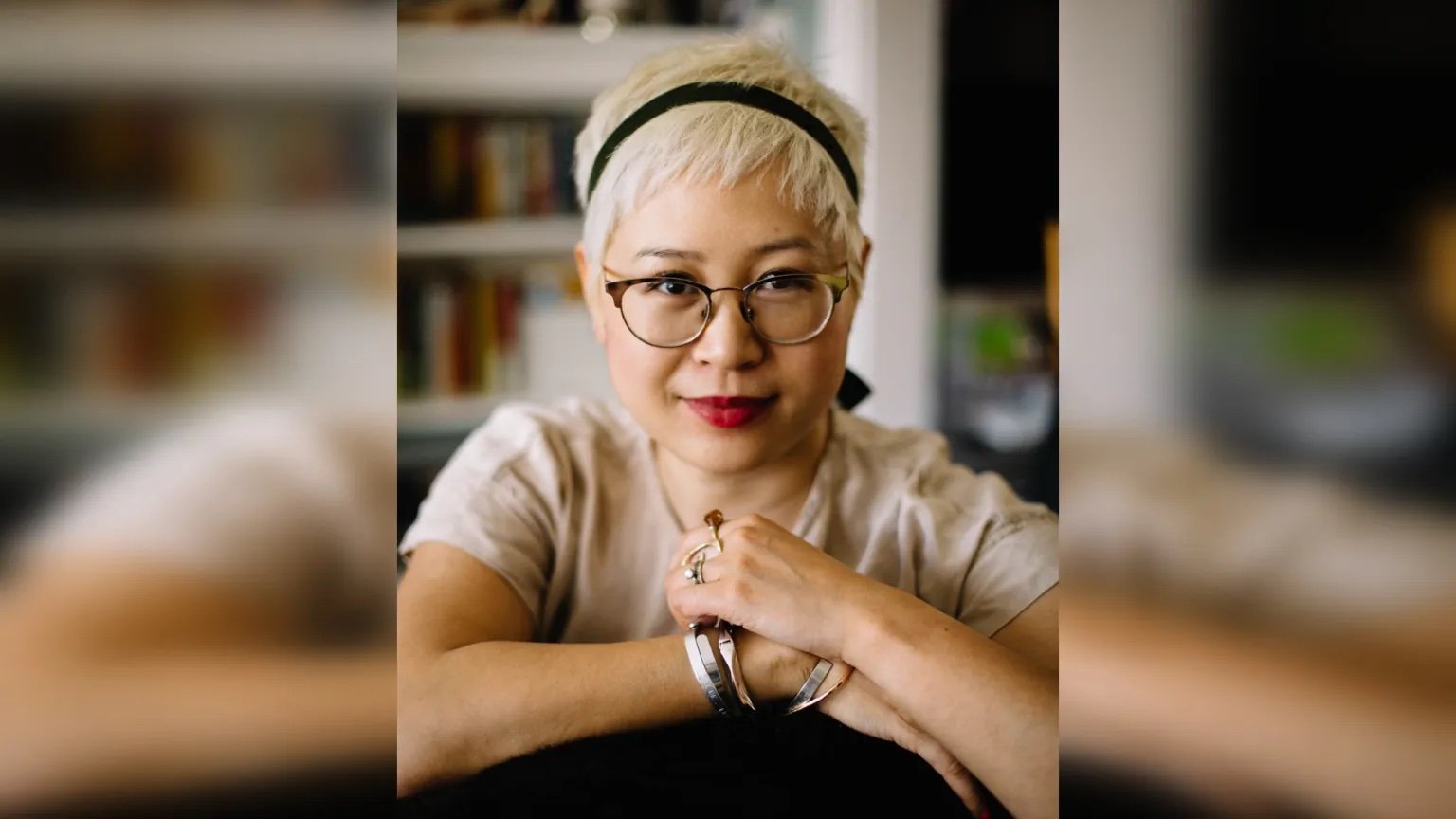
Reaping the Blooms: An Interview with Esmé Weijun Wang
Esmé Weijun Wang is a novelist and essayist. She is the author of the New York Times-bestselling essay collection, The Collected Schizophrenias (2019), for which she won the Graywolf Nonfiction Prize. Her debut novel, The Border of Paradise, was called a Best Book of 2016 by NPR and one of the 25 Best Novels of 2016 by Electric Literature. She was named by Granta as one of the “Best of Young American Novelists” in 2017 and won the Whiting Award in 2018. Born in the Midwest to Taiwanese parents, she lives in San Francisco, and can be found at esmewang.com and on Twitter @esmewang. Here, she talks with MFA candidate Audrey Deng about cultural stigmas around mental illness, “narrative therapy,” and academia.
Review: Thick, And Other Essays by Tressie McMillan Cottom
In college, I failed an anthropology assignment on thick description, the concept from which Dr. Cottom takes her title. I had tried to write descriptively and engagingly, like the writing major I was, though in her comments on my piece, the professor essentially told me I had forgotten to do the assignment. I wrote descriptively — almost creatively — but not anthropologically. I was missing the sociocultural lens she had asked us to apply; I had failed to see the patterns in the patrons behavior, how they served (and didn’t serve) as a microcosm of something bigger.